If your dog follows you from room to room, steals socks the second you sit down, or suddenly “forgets” their manners at night, you’re not alone. Many dogs aren’t “being bad” they’re under-stimulated. That’s where mental stimulation for dogs DIY can change everything. 🧠
The good news is you don’t need fancy puzzle feeders or a huge backyard. With a few household items and a little structure, you can create brain games that satisfy your dog’s natural instincts to sniff, shred, lick, search, and solve problems.
In this guide, you’ll learn practical mental stimulation for dogs DIY activities you can set up in minutes, how to scale them for puppies vs. adult dogs, and how to use positive reinforcement so your dog stays confident and motivated. By the end, you’ll have a simple weekly plan and a calmer dog to show for it.
💡 Why This Matters ?
A long walk helps, but many dogs still come home “wired.” That’s because physical exercise and brain work hit different needs. With mental stimulation for dogs DIY, you give your dog a job—something to figure out—and that’s incredibly satisfying.
Common frustrations like barking at nothing, chewing furniture, counter-surfing, and restless pacing often improve when your dog’s brain gets consistent enrichment. Enrichment also supports training because your dog learns to focus, problem-solve, and handle small frustrations without melting down.
Set realistic expectations: you may notice small improvements in 3–7 days, especially if you do 10–15 minutes daily. Bigger behavior changes (like reduced evening zoomies or calmer greetings) usually show up within 2–4 weeks of consistent mental stimulation for dogs DIY, paired with rewards and predictable routines. ✅
🧠 Section 1: Mental stimulation for dogs DIY basics (Start here)
Mental stimulation for dogs DIY works best when it matches what dogs naturally love: sniffing, foraging, licking, shredding (safely), and earning rewards. Think of these activities as “brain meals,” not random entertainment.
Start with short sessions so your dog stays successful. Puppies often do best with 2–5 minute games; adult dogs can handle 5–15 minutes depending on energy and frustration tolerance. Progress matters more than difficulty.
Here are easy DIY enrichment ideas you can rotate:
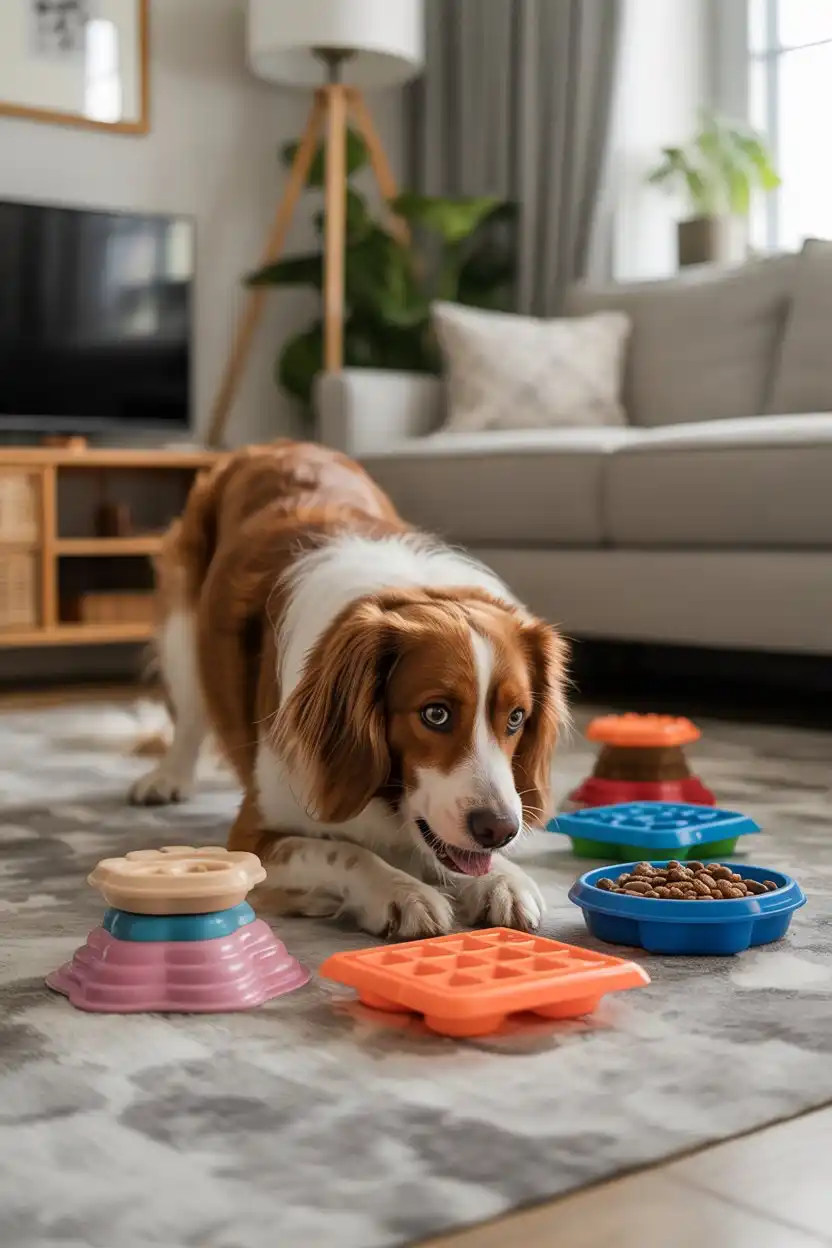
- Scatter feeding: toss kibble across a rug or lawn so your dog searches with their nose
- “Find it” treats: hide 5–10 treats behind chair legs or under cups
- Towel roll puzzle: roll treats into a towel and loosely knot it (supervise)
- Cardboard box search: drop treats into a box filled with paper balls
- Lick mat substitute: smear wet food thinly on a plate and freeze it
- Snuffle towel: sprinkle kibble into towel folds instead of a bowl
Tip: keep rewards tiny (pea-sized) so you can reinforce lots of wins without overfeeding.
Safety basics to follow every time:
- Supervise shredding-style games (towels, boxes) to prevent swallowing chunks
- Avoid string, rubber bits, or anything that can break into swallowable pieces
- If your dog guards food, do solo enrichment behind a gate to prevent conflict
✅ Section 2: Mental stimulation for dogs DIY step-by-step (15 games)
Use these mental stimulation for dogs DIY games like a menu. Pick 1–2 daily, then rotate to keep novelty high.
Game 1–5: Quick wins (great for puppies)
- Name game: say your dog’s name, mark (“yes”), treat when they look at you
- Hand target: present palm, reward nose touch, then move it around the room
- Cup shuffle (easy): hide treat under one cup, let them paw/nose it
- Treat trail: make a short line of treats leading to a jackpot
- Box in a box: treat inside a small box inside a bigger box
Game 6–10: Nosework + foraging
- Muffin tin puzzle: kibble in cups, cover with tennis balls
- Egg carton sniff: kibble inside carton (close loosely)
- “Find your toy”: hide one toy, reward when they bring it
- Scent swap: rub a treat on a cloth and hide the cloth (reward sniffing)
- Room search: place treats in 5 predictable “stations,” then release to hunt
Game 11–15: Calm focus (amazing for evenings)
- Settle on mat: reward calm lying down on a towel/mat
- Stuffed frozen food: use a rubber toy or a safe DIY container you can clean
- Pattern games: “1-2-3 treat” while walking inside to build focus
- Slow treat delivery: reward only when your dog sits quietly
- Choice-based game: hold two hands closed, reward for backing off/politeness
Common mistakes to avoid (these cause many “this didn’t work” moments):
- Mistake: making puzzles too hard on day one (your dog quits or gets frantic)
- Mistake: leaving DIY items unsupervised (box/towel shredding can become unsafe)
- Mistake: only using high arousal games (your dog gets hyped, not calm)
Tip: if your dog is struggling for more than 10 seconds, make it easier immediately so they keep winning.
🏆 Section 3: Mental stimulation for dogs DIY advanced rotations (and signs it’s working)
Once your dog understands the “game idea,” you can build real brain power by adding small challenges—without tipping into frustration. Advanced mental stimulation for dogs DIY should still feel fun and achievable.
Try these upgrades:
- Add a “wait” before releasing to the search (impulse control + sniffing)
- Increase hiding spots gradually (behind doors, under furniture edges)
- Use multiple textures (paper, towels, plastic cups) to vary problem-solving
- Combine skills: “go to mat” → “wait” → “find it” → “settle”
Real-world examples you can copy:
- Before dinner, do 5 minutes of scatter feeding so your dog arrives at the bowl calmer.
- When guests come over, give a frozen lick option so your dog stays busy and relaxed.
- On rainy days, run a three-game circuit: cup shuffle → room search → mat settle.
Success indicators to look for:
- Sign: your dog sniffs more and paces less after the activity
- Sign: quicker “settle” time in the evening (often within 1–2 weeks)
- Sign: fewer attention-seeking behaviors like pawing or barking at you
Troubleshooting common issues (fast fixes):
- If your dog gets frantic, lower difficulty and switch to licking or mat work.
- If your puppy bites towels/boxes, use food scatter on a snuffle towel you hold.
- If your dog gives up, increase reward value and shorten the game to 30–60 seconds.
Safety: avoid DIY items with staples, tape fragments, or small plastic that can splinter.
🎥 Video Resource Section
❓ Common Questions
Q: How often should I do mental stimulation for dogs DIY? 🐾
Aim for 10–15 minutes daily, or 2–3 mini sessions of 3–5 minutes.
Q: Is this safe for puppies who chew everything? 🦴
Yes, if you supervise and choose low-risk games like scatter feeding, hand targets, and easy sniff searches.
Q: My dog destroys boxes—should I stop? 📦
Not necessarily. Allow supervised shredding if they don’t swallow pieces, but switch to safer options if they ingest cardboard.
Q: Can mental games replace walks? 🚶
They help a lot, but most dogs still need physical movement. Combine sniffing games with short walks for best results.
🎉 Conclusion & Next Steps
Mental stimulation for dogs DIY is one of the quickest ways to help your dog feel calmer, happier, and more “easy to live with.” Start simple, keep games short, and use positive reinforcement so your dog stays confident. 🐕🦺
This week, pick 5 games from the list and rotate 1–2 per day. If your dog struggles, lower the difficulty and celebrate small wins. With consistent mental stimulation for dogs DIY, you’ll usually notice better settling and fewer boredom behaviors within 2–4 weeks. ✅