Is there anything worse than staring out the window at the pouring rain while your dog stares at you with that pleading, energetic look? We have all been there. You know they need activity, but a long walk just isn’t in the cards. Finding 7 things to do with your dog at home isn’t just about killing time; it is about saving your sanity and your furniture.
When we are stuck indoors, whether due to bad weather, illness, or just a busy schedule, our dogs can quickly become restless. This pent-up energy often manifests as barking, chewing, or zooming around the house at inopportune times. But here is the good news: you don’t need a massive backyard or fancy equipment to tire your dog out.
In this guide, we are going to explore creative, enriching ways to engage your pup without leaving your living room. From nose work that engages their primal instincts to teaching useful household manners, you will learn how to turn a boring afternoon into a productive training session. Get ready to transform your indoor time from frustrating to fun!
Why This Matters for Your Dog 💡
You might be thinking, “Can’t they just nap?” While dogs do need plenty of sleep, they also crave stimulation. Learning 7 things to do with your dog at home is crucial because mental stimulation is often far more tiring for a dog than physical exercise alone.
A 15-minute intense training session or brain game can be the equivalent of a 45-minute walk in terms of energy expenditure. When you engage your dog’s brain, you aren’t just wearing them out; you are fulfilling a biological need. Dogs are natural problem solvers. When we don’t give them problems to solve (like a puzzle toy), they often create their own problems (like unrolling the toilet paper).
By implementing these indoor activities, you will notice a significant decrease in “naughty” behaviors. Furthermore, working with your dog one-on-one builds a stronger bond. You become the source of all fun and rewards, which translates to better focus and obedience when you eventually do go back outside.
Benefits of Indoor Enrichment:
- Reduces Anxiety: meaningful activity lowers stress hormones.
- Saves Your Home: a bored dog is a destructive dog.
- Improves Focus: engaging games sharpen their listening skills.
- Accessible: great for senior dogs or puppies who can’t walk far yet.
It is also recommended to read :
The Ultimate Dog Training Tips: Proven Steps for Better Behavior
The Ultimate Siberian Husky Training Guide: Calm & Focused
Essential puppy biting training tips: Stop nipping fast
Engaging the Nose and Brain 🎓
The first category of our 7 things to do with your dog at home focuses on their most powerful sense: smell. A large portion of a dog’s brain is dedicated to analyzing scents. These three activities are low-impact for you but high-reward for them.
1. The “Find It” Game (Hide and Seek)
This is a classic for a reason. It teaches your dog to rely on their nose rather than their eyes.
- Start Simple: Have your dog “sit” and “stay” (or hold their collar). Show them a high-value treat.
- Placement: Place the treat in plain sight a few feet away. Say “Find it!” enthusiastically.
- Escalate: Once they get the hang of it, hide the treat behind a table leg, under a chair, or in another room.
- Tip: If you make homemade dog treats, this is the perfect time to use them! The scent will be stronger and more motivating.
2. The Muffin Tin Puzzle
You don’t need to buy expensive puzzle toys to challenge your dog’s brain.
- Setup: Take a standard muffin tin and place a few pieces of kibble or small treats in the cups.
- The Challenge: Cover each cup with a tennis ball or a crumpled-up piece of paper.
- The Goal: Your dog must figure out how to knock the ball off or lift it up to get the reward.
- Observation: Watch how they solve it—do they use their paw or their nose? This gives you insight into their learning style.
3. The Shell Game
This is the canine version of the classic street magic trick.
- Equipment: Get three identical plastic cups (yogurt containers work well).
- The Process: Show your dog a treat and place it under one cup. Shuffle them slowly.
- The Release: Let your dog sniff out the correct cup. When they nose or paw the right one, lift it and let them eat the treat immediately.
Essential Tips for Success:
- Use smelly treats (cheese, hot dogs, or freeze-dried liver) to make the scent easier to track initially.
- Keep sessions short (5-10 minutes) so your dog doesn’t get frustrated.
- Always end on a win—if they are struggling, make the last round incredibly easy so they finish feeling confident.
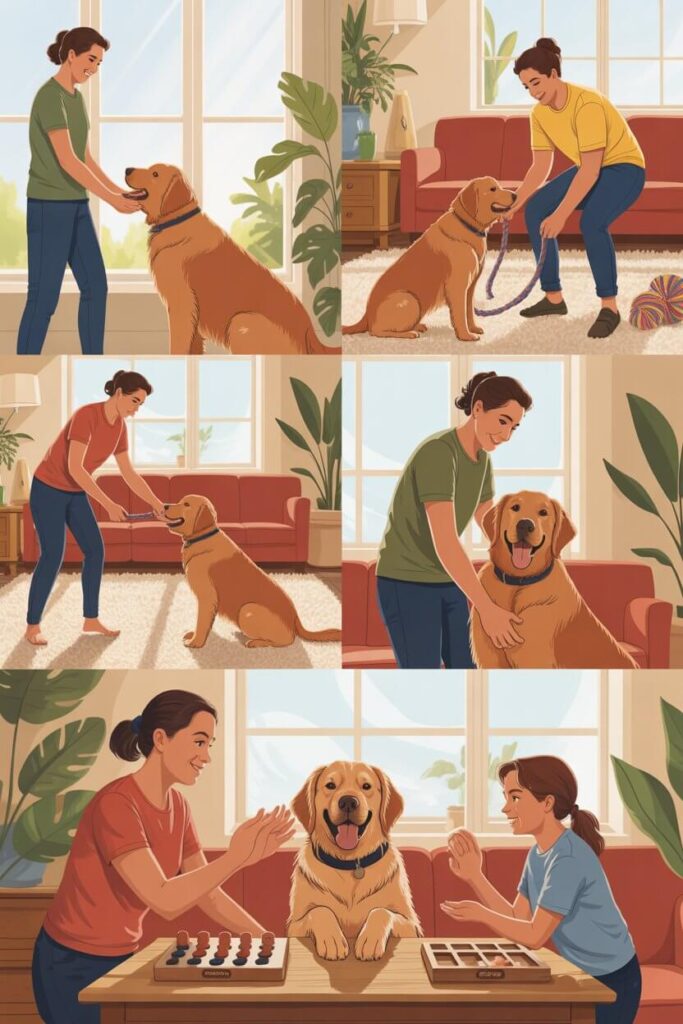
Teaching Functional Household Skills ✅
Moving on to the next set of activities, we focus on skills that are actually helpful around the house. These count towards our 7 things to do with your dog at home because they double as behavior management.
4. The “Clean Up” Game
Imagine if your dog put their own toys away! This is a complex chain behavior that provides immense mental stimulation.
- Step 1: Place a toy box or basket near you.
- Step 2: Encourage your dog to pick up a toy. When they are holding it over the box, command “Drop it.”
- Step 3: As the toy falls into the box, click (if clicker training) or say “Yes!” and reward heavily.
- Step 4: Gradually shape the behavior so they have to carry the toy to the box before dropping it.
5. Perfecting the “Place” Command
This is arguably one of the most useful commands for a food blogger or anyone who spends time in the kitchen. “Place” means “go to your bed/mat and stay there until released.”
- The Setup: Put a specific mat or bed in the corner of the room.
- Luring: Lure your dog onto the mat with a treat. As soon as all four paws are on it, reward.
- Adding Duration: Ask for a “Down.” Feed them treats consecutively while they stay on the mat.
- Distance: Take one step away, then return and reward. Slowly increase the distance and the distractions (like opening the fridge).
Best Pet Training Products We Recommend
Product | Product Name | Rating | See Today’s Price |

| Dog Training Clicker with Wrist Strap | ; | |

| Adjustable No-Pull Dog Harness (Training & Walking) | ; | |

| Pet Training Treat Pouch (Hands-Free Snack Bag) | ; | |

| Interactive Dog Training Toy (Mental Stimulation) | ; | |

| Cat & Dog Potty Training Pads (Super Absorbent) | ; |
Common Mistakes to Avoid:
- Moving too fast: If your dog breaks the “Place” stay, you likely moved too far away too quickly. Go back a step.
- Using a boring reward: For difficult tasks like “Clean Up,” dry kibble usually isn’t enough motivation. Use high-value rewards.
- Fading the lure too late: Try to stop holding the treat in front of their nose as soon as they understand the concept, or they will only obey when they see food.
Physical Fun in Small Spaces 🏆
We have covered brain games and skills, but what about burning physical energy? The final items on our list of 7 things to do with your dog at home involve getting the body moving safely indoors.
6. Indoor Obstacle Course (DIY Agility)
You don’t need A-frames and tunnels to do agility. You can use your living room furniture.
- The Tunnel: Drape a blanket over two chairs to create a tunnel. Lure your dog through it.
- The Jump: Use a broomstick resting on two books (keep it very low for safety) and encourage your dog to step or hop over it.
- The Weave: Set up a line of plastic water bottles or cones and lure your dog in a zig-zag pattern through them.
- Safety Note: Do this on a carpeted area or a yoga mat. Never do jumping exercises on slippery tile or hardwood floors, as your dog could slip and injure a ligament.
7. Controlled Tug-of-War
Tug is often misunderstood as creating aggression, but when played with rules, it is an excellent exercise for impulse control and physical exertion.
- The Rules: The game only starts when you say “Take it.”
- The Drop: You must be able to stop the game at any moment. Ask for a “Drop it.” If they don’t drop, the game pauses and you become boring until they let go.
- The Reward: The game restarting is the reward for dropping the toy.
- Success Indicator: Your dog should be looking to you for permission to grab the toy, rather than blindly lunging for it.
Signs of Progress:
- Your dog waits patiently for the “Take it” command.
- They navigate the obstacle course with confidence rather than fear.
- They are panting happily after just 10 minutes of play.
Video Tutorial Guide 🎥
Frequently Asked Questions ❓
Q: My dog isn’t interested in toys or games, just food. What should I do?
A: That is actually great! Use their daily meal allowance for these training games. Instead of putting their food in a bowl, use that kibble for the Muffin Tin puzzle, the “Find It” game, or for practicing “Place.” A food-motivated dog is usually easier to train than a toy-motivated one.
Q: How long should we play these indoor games?
A: Keep sessions short. For mental work (like the shell game or learning “clean up”), 5 to 10 minutes is plenty. Dogs fatigue mentally very quickly. You can do 2 or 3 of these short sessions throughout the day rather than one long hour-long session.
Q: Is the obstacle course safe for puppies?
A: Be very careful with jumping. Puppies have open growth plates, and repetitive impact can cause long-term joint damage. For puppies, keep the “jumps” as just stepping over a broomstick on the ground (no height) and focus more on the tunnels and weaving, which are low-impact.
Q: Can I do these things with an older, senior dog?
A: Absolutely! Nose work (Game #1 and #2) is perfect for seniors who may have limited mobility or failing eyesight but still have a sharp nose. Just skip the high-impact agility and focus on the brain games to keep their cognitive function sharp.
Conclusion & Your Next Steps 🎉
Being stuck inside doesn’t have to be a sentence to boredom for you or your pup. By trying these 7 things to do with your dog at home, you are turning downtime into prime bonding time. Whether you are hiding treats for a game of “Find It” or building a blanket fort tunnel in the hallway, you are providing the essential enrichment your dog needs to stay happy and calm.
Your Next Step:
Don’t try to do all seven things today! Pick one activity from the list—perhaps the Muffin Tin puzzle since you likely have the supplies in your kitchen right now—and give it a try for 10 minutes.
Grab some treats, clear a little space on the living room floor, and have fun connecting with your best friend. You might just find that you enjoy these indoor days as much as they do! 🐕✅