
If you just brought home a Golden Retriever puppy, your day probably looks like this: a cute face, a chewed shoelace, a surprise pee spot, and a zoomie sprint around your living room. 😅 You’re not alone.
This guide to 7 Golden Retriever Puppy Training Tips is made for real life busy mornings, tired evenings, and everything in between. Goldens are smart, social, and eager to please, but they’re also mouthy, excitable, and easily distracted as puppies.
You’ll learn a clear, positive reinforcement approach that helps your puppy understand what to do (instead of guessing what not to do). You’ll also get equipment recommendations, age-appropriate expectations, and a realistic timeline so you don’t feel behind.
By the end, you’ll have a simple training plan you can start today—without needing harsh corrections or complicated techniques.
💡 Why This Matters ?
Golden Retrievers grow fast, and their habits grow even faster. A behavior that feels “kinda cute” at 4 months—jumping, mouthing, pulling can become a real problem when your pup hits 25–30 kg as an adult.
The biggest benefit of early training is clarity. Your puppy learns how to succeed in your home, and you stop feeling like you’re constantly reacting to chaos. 🧠
Common frustrations you can prevent (or fix) with the right plan:
- Accidents that keep happening “for no reason”
- Shark-teeth biting during play
- Barking or whining in the crate
- Pulling hard on leash to greet everyone
Most puppies show noticeable improvement in 2–4 weeks with consistent daily practice. Bigger goals—like reliable leash manners or calm greetings—often take 8–12 weeks.
You don’t need perfection. You need repetition, good timing, and rewards that make sense to your puppy.
🎓 Section 1: 7 Golden Retriever Puppy Training Tips (Start Here)
These first tips build the foundation for everything else. Keep sessions short—3–5 minutes—so your puppy stays successful.
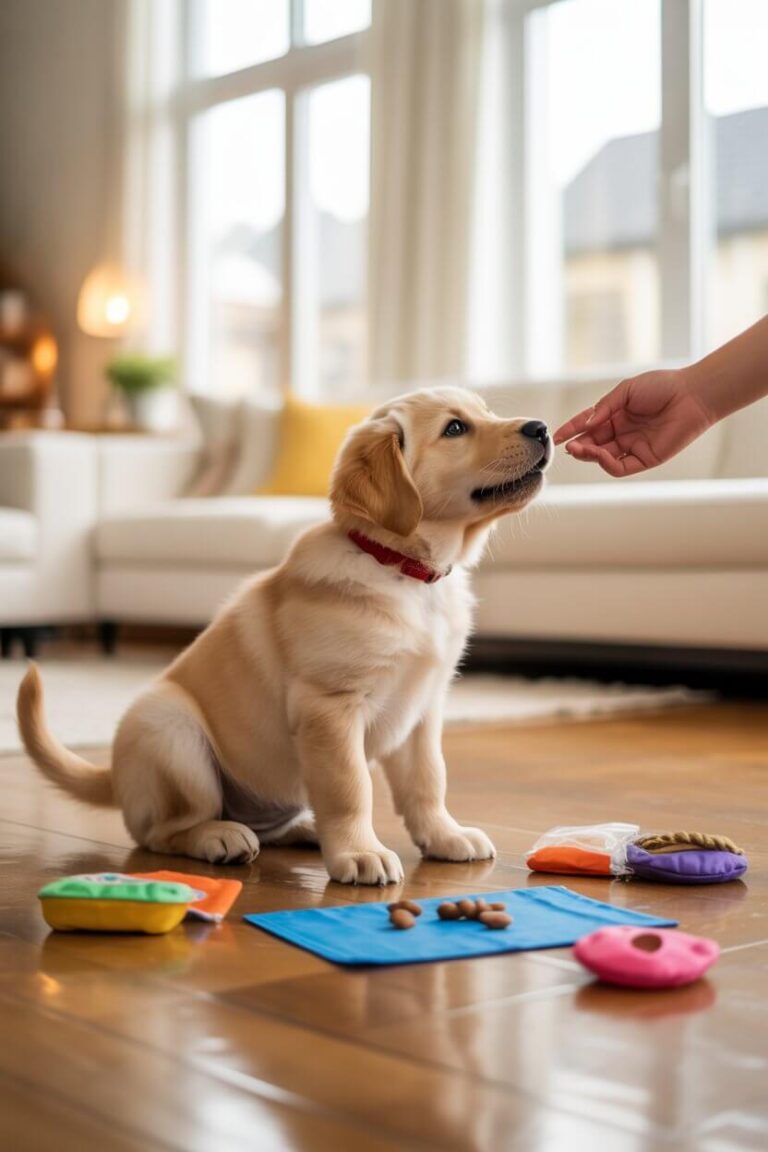
Tip 1: Reward what you like (a lot).
Golden puppies repeat what pays off. If “four paws on the floor” earns treats and attention, that becomes their default.
Practical ways to do it:
- Keep a treat jar in 2–3 rooms
- Reward calm behaviors you didn’t “ask for”
- Mark the moment with “Yes!” or a clicker
Tip 2: Teach your puppy their name + a check-in.
This is your steering wheel outdoors and your reset button indoors.
Try this:
- Say the name once
- When they look at you, say Yes and reward
- Repeat 10 times, 2 times daily
Tip 3: Use a schedule for potty success.
Potty training fails most often because freedom comes too soon.
A simple puppy schedule:
- Outside after waking, after eating, after play, and every 30–60 minutes
- Reward immediately after they finish
- Supervise or confine when you can’t watch
Equipment that helps:
- A crate sized so your puppy can stand/turn (not pace)
- Baby gates to limit wandering
- Enzyme cleaner (regular soap won’t remove odor fully)
✅ Section 2: 7 Golden Retriever Puppy Training Tips (Step-by-Step Skills)
Now you’ll install the “life skills” that prevent the most common Golden puppy headaches.
Tip 4: Stop biting by training an off-switch.
Biting is normal for puppies, especially during teething (12–24 weeks). Your job is to teach what to bite and how to calm down.
Steps:
- Start play with a toy already in your hand
- The moment teeth hit skin, pause and get still
- Redirect to a chew toy and reward when they bite it
- If biting continues, do a 20–40 second calm break behind a gate
Common mistake to avoid: Yelling or pushing your hand into the mouth “to show them.” It often increases arousal and biting.
Safety note: Provide legal chews sized appropriately to prevent choking, and supervise bully sticks or similar items.
Tip 5: Crate train for calm, not confinement.
Crate training works best when the crate predicts good things.
Steps:
- Feed 1 meal per day in the crate (door open)
- Toss treats in, let your puppy enter/exit freely
- Close the door for 10 seconds while they chew, then open
- Gradually extend time while they stay relaxed
Success indicator: your puppy chooses to nap in the crate with the door open.
🏆 Section 3: 7 Golden Retriever Puppy Training Tips (Leash + Troubleshooting)
This is where your puppy becomes easy to live with in public—and where most owners get stuck.
Tip 6: Teach loose-leash walking indoors first.
Your puppy can’t “out-obey” exciting smells outside until the skill is built inside.
Steps:
- Clip leash to a front-clip harness
- Take 3–5 steps in the house
- Reward by your left or right leg (pick one side)
- If they pull, stop and wait for slack, then move again
Common mistake to avoid: dragging your puppy forward. Pulling becomes the habit.
Tip 7: Train polite greetings (no jumping).
Goldens love people. You’re not training friendliness away—you’re shaping it.
What to do:
- Ask visitors to ignore jumping completely
- Reward sitting or standing calmly
- Use a leash or baby gate during greetings
Troubleshooting common issues:
- If accidents continue: reduce freedom, increase outside trips, and reward faster
- If crate whining escalates: shorten crate time and add more chew enrichment
- If leash pulling is constant: practice after a short play session when energy is lower
Real-world example: If your puppy jumps when guests enter, leash them before opening the door and reward calmness every 2–3 seconds for the first minute.
🎥 Video Resource Section
❓ Common Questions
Q: When should I start training these behaviors? 🐶
Now. You can start gentle training the first day home, keeping sessions short and upbeat.
Q: What treats work best for Golden Retriever puppies? 🍗
Soft, pea-sized treats. Use part of their daily kibble for easy reps, and save higher-value treats for distractions.
Q: What if my puppy is scared outside? ⚠️
Don’t force it. Increase distance from triggers, reward curiosity, and keep outings brief until confidence grows.
Q: Do I need a trainer, or can I do this alone? 🎓
Many owners succeed solo, but a positive-reinforcement puppy class can speed progress and improve social skills safely.
🎉 Conclusion & Next Steps
You don’t need 20 tricks—you need the core habits from 7 Golden Retriever Puppy Training Tips practiced consistently. ✅ Focus on rewarding calm behavior, building potty and crate routines, redirecting biting, and teaching leash skills indoors before expecting success outside.
Start with 2 short sessions per day plus “real life rewards” (treating good choices you notice). Within 2–4 weeks, you should see fewer accidents, less biting, and faster responses to your voice.
When these basics feel steady, your next step is advanced socialization, longer settle-stays, and distraction-proof recall. If you want faster results, track progress daily and adjust your environment before you blame your puppy. 🐕