If you’ve ever tried teaching “shake” and your dog just stares at you like you’re speaking another language, you’re not alone. The good news is that most dogs aren’t being stubborn—they’re just confused about what pays off. That’s why focusing on tricks to teach your dog with clear steps (and great rewards) changes everything.
Trick training isn’t only for showy party moments. It’s a simple way to burn energy, improve focus, and build a “we understand each other” bond at home. 🎓 It also helps nervous dogs gain confidence and helps busy dogs channel their energy into something productive.
In this guide, you’ll learn a practical set of tricks to teach your dog (from easy to impressive), exactly how to train them using positive reinforcement, what equipment helps most, and how to troubleshoot the common “why isn’t this working?” moments.
💡 Why This Matters ?
Teaching tricks to teach your dog is one of the easiest ways to improve everyday behavior without turning training into a stressful chore. When your dog learns how to learn, they start offering attention, trying new behaviors, and responding faster because training becomes a fun game rather than a lecture.
A lot of dog owners feel frustrated because they expect results in one session. That’s a normal expectation—but dogs learn best in short, repeatable reps across days. ✅ With a realistic timeline, you’ll stop wondering if you’re doing it “wrong” and start seeing steady progress.
Trick training also supports real-life skills. “Touch” can help with leash walking, “place” helps with calm greetings, and “drop it” can prevent dangerous chewing. Your goal isn’t perfection—it’s progress, built through rewards, consistency, and a plan that fits your dog’s age and personality.
🎓 Section 1: Tricks to teach your dog (starter foundations) 🐾
Before you jump into the fun stuff, set up your foundation so your dog wins early. Your best results come from training when your dog is slightly hungry (not starving), in a low-distraction room, and with rewards they genuinely love.
Use a reward marker (a clicker or a short word like yes). The marker tells your dog, “That exact moment earns a reward,” which speeds learning dramatically. Timing matters more than fancy technique.
Equipment that helps:
- Treat pouch so rewards are fast
- Pea-sized soft treats (or kibble for easy dogs)
- Clicker (optional but helpful)
- Non-slip mat for “place” and safer movement
Practical tips to start strong:
- Tip: Train in 3–5 minute sessions, 1–3 times daily.
- Keep your cues consistent (say it once, then help).
- End after a win so your dog stays eager next time.
Easy starter tricks to build momentum (choose 2–3 first):
- “Sit” and “Down” (focus and impulse control)
- “Touch” (nose to hand target)
- “Paw” (simple body awareness)
- “Spin” (great for energetic dogs)
Puppies vs adult dogs: Puppies need shorter sessions and more breaks. Adult dogs can focus longer, but they may have habits to overcome—so keep your criteria easy at first.
Safety note: avoid repetitive jumping tricks for young puppies and large breeds on slippery floors. Traction prevents strain.
✅ Section 2: Tricks to teach your dog step-by-step (with troubleshooting) 🧠
Here’s a simple training pattern you can reuse for almost all tricks: lure or capture → mark → reward → add cue → reduce help → practice in new places. Keep it predictable, and your dog relaxes into learning.
Step-by-step: Teach “Touch” (fastest confidence builder)
- Present your open palm a few inches from your dog’s nose.
- The moment they sniff/boop it, mark (
yes) and reward. - Repeat until they’re quickly seeking your hand.
- Add the cue “touch” right before you present your hand.
- Gradually move your hand to the side, higher, lower, then take 1–2 steps away.
Tip: If your dog won’t approach, use a higher-value treat (tiny cheese or chicken) for the first 10 reps.
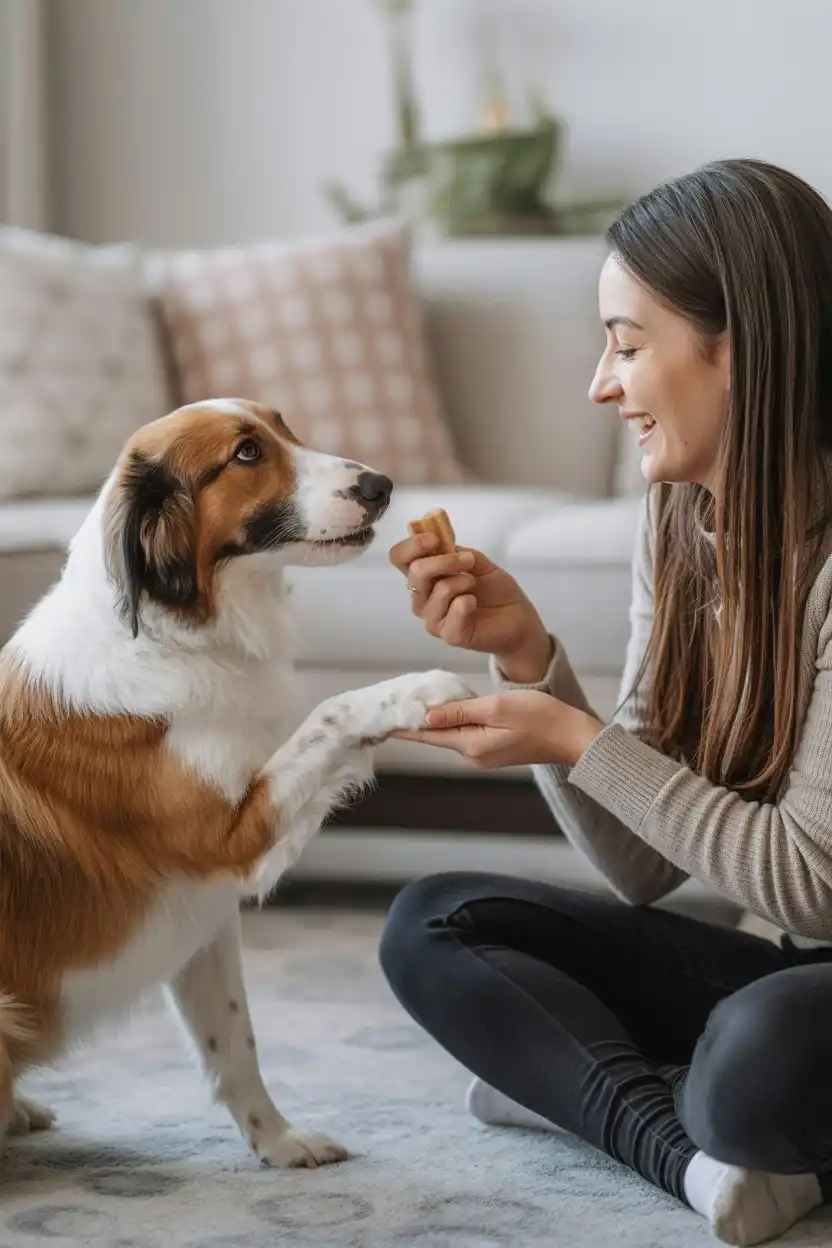
Step-by-step: Teach “Paw”
- Ask for “sit.”
- Hold a treat in your closed fist near their chest.
- Wait for any paw movement toward your fist.
- Mark the paw movement and reward from the other hand.
- Add the cue “paw” once the motion is consistent.
Common mistakes to avoid:
- Repeating the cue (“paw paw paw”) teaches your dog to ignore the first ask.
- Moving too fast and expecting the full behavior in one day.
- Rewarding late (your dog thinks the reward was for standing up or walking away).
Troubleshooting quick fixes:
- If your dog bites hands: switch to “touch” on a target stick or closed fist and reward lower.
- If your dog gets frustrated: make the next rep easier and pay more.
- If distractions ruin progress: go back indoors and rebuild success first.
Realistic timeline: many dogs learn “touch” in 1–3 days, “paw” in 3–7 days, and fluent response in 2–3 weeks with consistent practice. Consistency beats long sessions.
🏆 Section 3: Tricks to teach your dog (advanced combos and polish) 🎯
Once your dog understands how training works, you can level up by chaining tricks and adding distance, duration, and distraction. This is where tricks start looking “impressive,” even though your training stays simple.
Advanced techniques that make tricks look professional:
- Reward faster for effort at first, then gradually raise criteria.
- Use a variable schedule (not every rep pays) once the trick is solid.
- Practice in 3 locations: kitchen, hallway, outside—generalization matters.
Impressive tricks that build on basics:
- “Spin” + “Sit” combo (mental focus + body control)
- “Place” (go to mat and relax) for real-life calm
- “Leave it” and “Drop it” as safety tricks
- “Heel” for 5 steps as a mini-game, not a march
Success indicators you’re on track:
- Your dog offers the behavior quickly after the cue.
- They recover easily after mistakes (no stress signs).
- They can do it with mild distractions (a toy on the floor).
Example training win: your dog learns “touch,” then you use it to guide them onto a mat, then you reward calm. That’s trick training becoming life training.
Age considerations: for puppies, keep “place” short (2–5 seconds). For seniors, choose low-impact tricks like “touch,” “chin rest,” or “find it” instead of spins on hard floors. Comfort always comes first.
🎥 Video Resource Section
❓ Common Questions
Q: How many tricks to teach your dog at once? 🐕
A: Stick to 1–2 new tricks at a time. Keep a third trick as an “easy win” to build momentum.
Q: What if my dog only works for treats? 🍗
A: That’s normal early on. Gradually mix in praise, toys, and real-life rewards (like going outside) once the behavior is consistent.
Q: Are tricks safe for puppies? 🧸
A: Yes, if they’re low-impact. Avoid repeated jumps, sharp pivots on slippery floors, and long sessions.
Q: My dog does the trick at home but not outside—why? 🌳
A: Dogs don’t generalize well. Practice the same trick in new places with easier criteria and higher-value rewards at first.
🎉 Conclusion & Next Steps
Teaching tricks to teach your dog is one of the fastest ways to build focus, confidence, and a happier daily routine. Start with “touch” and “paw,” keep sessions short, reward the moments you like, and increase difficulty slowly. ✅ You’ll usually see noticeable progress within a week, and real reliability in 2–3 weeks.
Your next step: pick two tricks, schedule 5 minutes daily, and track wins (even tiny ones). When those are solid, add an advanced combo like “touch → place” or “spin → sit.” 🏆 If you want, I can also create a 14-day trick calendar tailored to your dog’s age and energy level.