Congratulations! You’ve just brought home a bundle of joy wrapped in soft fur and floppy ears. There is truly nothing quite like the love of a Labrador Retriever. But let’s be honest for a second—along with those soulful eyes and puppy breath comes a whirlwind of energy, sharp teeth, and a little bit of chaos. If you are feeling overwhelmed, take a deep breath; you are in the right place.
Raising a Lab is a rewarding journey, but it requires patience and a solid game plan. Many new owners struggle with the “Land Shark” phase or the boundless energy that this breed is famous for. This article is designed to be your roadmap. We are going to cover the most effective Labrador puppy training tips to help you navigate the first few crucial months.
By the end of this guide, you will understand how to harness your puppy’s natural intelligence and food motivation to build a relationship based on trust and respect. You will learn practical techniques to stop unwanted behaviors and instill good manners that will last a lifetime. Let’s turn that energetic puppy into the best dog you’ve ever owned!
Why This Matters for Your Dog 💡
You might be thinking, “My puppy is just a baby, can’t I let him be wild for a while?” While it’s tempting to let cute behaviors slide, it is vital to remember that your 15-pound ball of fluff will soon be a 70 or 80-pound powerhouse. A puppy jumping up to say hello is adorable; a full-grown Labrador knocking over your grandmother is a liability.
Implementing proper Labrador puppy training tips early on isn’t just about obedience; it’s about safety and mental health. Labradors are working dogs. They were bred to retrieve all day in freezing water. If you don’t give them a job or structured training, they will “employ” themselves—usually by chewing your baseboards or digging up your garden.
Training provides the mental stimulation that Labs crave. It burns off energy more effectively than a walk around the block ever could. By establishing boundaries now, you save yourself years of frustration later. Plus, a well-trained dog gets to go more places, meet more people, and live a fuller, happier life. Investing time now pays dividends for the next 12 to 14 years.
Section 1: Laying the Foundation (Housebreaking & Crate Training) 🎓
Before we get into fancy tricks, we need to handle the basics of living together. Labradors are generally clean dogs, but they have high metabolisms as puppies, meaning they need to go out a lot.
The Crate is Your Best Friend
Many new owners feel guilty about using a crate, but for a Labrador, it is an essential safety tool. Think of it as their bedroom, not a jail cell.
- Create Positive Associations: Never use the crate as punishment. Feed your puppy their meals inside the crate so they associate it with good things.
- Size Matters: The crate should be big enough for them to stand up and turn around, but not so big that they can pee in one corner and sleep in the other. Use a divider if necessary.
- The “Quiet” Rule: If your puppy cries in the crate, wait for a moment of silence before letting them out. If you open the door while they are barking, you are teaching them that Barking = Freedom.
Potty Training Success
Labradors are smart, but they don’t speak English. You have to show them where to go.
- The 30-Minute Rule: Take your puppy out every 30 minutes when they are awake, and immediately after eating, sleeping, or playing.
- Throw a Party: When they do their business outside, act like they just won the lottery. Use high-value treats and enthusiastic praise.
- Supervision is Key: If your puppy is not in the crate, they should be tethered to you or under direct supervision. Accidents happen when we take our eyes off them for “just a second.”
Socialization vs. Exposure
Socialization doesn’t mean letting your puppy run up to every dog they see. For a friendly breed like a Lab, it means teaching them to be calm around new things.
- Neutrality is the Goal: You want your puppy to see a person or another dog and think, “Oh, cool,” and keep walking, rather than dragging you toward them.
- Surface Training: Expose your puppy to different surfaces (grass, gravel, tile, carpet) to build confidence.
Section 2: Taming the “Land Shark” & Manners ✅
If you look at your arms and see scratches and nip marks, welcome to the club. Labrador puppies are often affectionately called “Land Sharks” because they explore the world with their mouths. This is natural retriever behavior, but it hurts!
Bite Inhibition and Redirection
You cannot simply tell a Lab to stop using their mouth; you have to teach them what to use their mouth on.
- The Exchange Method: Whenever your puppy tries to nip your hand or pant leg, immediately put a toy in their mouth. You are saying, “Don’t bite skin, bite this.”
- The “Ouch” Technique: If teeth touch skin, give a high-pitched “Ouch!” and go limp. This mimics how littermates play. If they bite too hard, play stops. This teaches them to be gentle.
- Time-Outs: If the biting is relentless, your puppy is likely overtired. Quietly put them in their crate or a playpen for a nap. Puppies get “zoomies” and bite more when they are exhausted.
The “Drop It” Command
For a retriever, holding things is instinctual. “Drop it” is a safety command that every Lab owner must master.
- Offer a Trade: When your puppy has a toy, offer a high-value treat right in front of their nose.
- The Switch: As they open their mouth to take the treat, say “Drop It.”
- Reward: Give them the treat and praise them.
- Repeat: Do this frequently with low-value toys before trying it with socks or shoes.
- Common Mistake: Do not chase your puppy to get an item back. To a Lab, being chased is the best game in the world. You are reinforcing the behavior you want to stop. Always trade up!
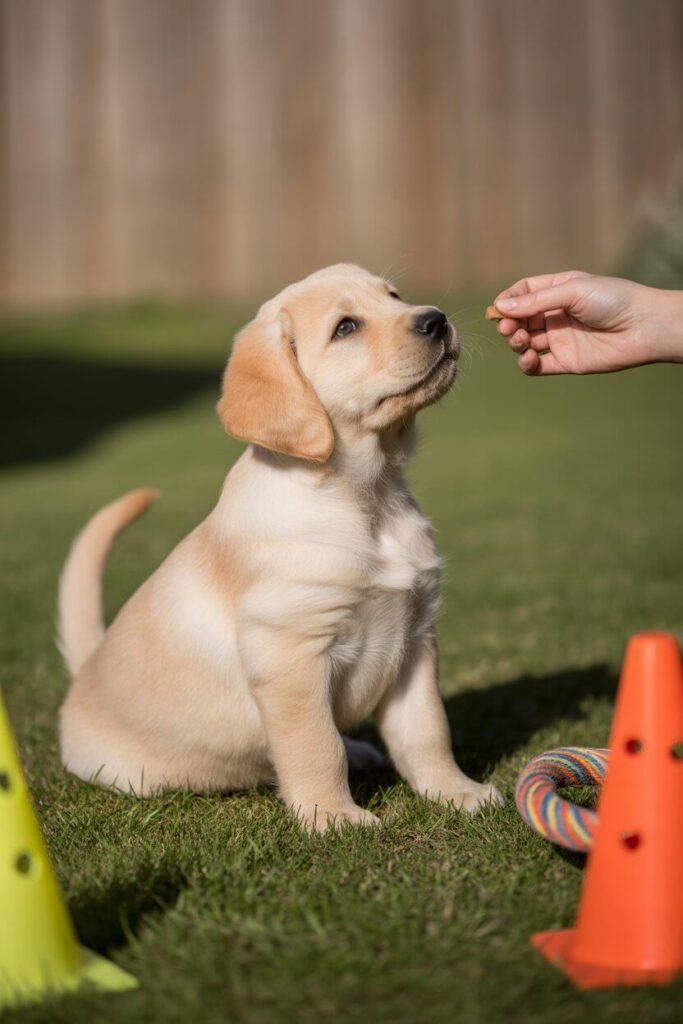
Jumping Up
Labs love faces. They want to lick you, smell you, and be near you. But a jumping dog is a nuisance.
- Four on the Floor: Only pet your puppy when all four paws are on the ground. If they jump up, turn your back and cross your arms. Ignore them completely.
- The Sit Greeting: Teach your puppy that the only way to get attention is to sit. Ask for a “sit” before you pet them. If they pop up, stand up and ignore again. Consistency is crucial here everyone in the family must follow this rule.
It is also recommended to read :
Step-by-Step Puppy Training Schedule: What to Teach and When
20 Hiking With Dogs Tips
15 Fun Things to Do for Your Dogs Birthday
Master Indoor Fun: 7 Things to Do With Your Dog at Home Today
Section 3: Advanced Impulse Control 🏆
Once your puppy has mastered the basics, it’s time to work on impulse control. Labradors are highly food-motivated and impulsive. Teaching them to wait is one of the most powerful Labrador puppy training tips you can implement.
The “Leave It” Command
“Drop it” is for things in their mouth; “Leave it” is for things they want to pick up. This can save your dog’s life if you drop medication or dangerous food on the floor.
- Step 1: Hold a treat in a closed fist. Let your puppy lick and paw at your hand. Say nothing.
- Step 2: The moment they pull their nose away or stop trying, say “Yes!” and give them a treat from your other hand.
- Step 3: Repeat until they look at your fist and then immediately look at you. Add the cue “Leave It.”
- Step 4: Progress to putting the treat on the floor covered by your hand, then eventually uncovered.
Best Pet Training Products We Recommend
Product | Product Name | Rating | See Today’s Price |

| Dog Training Clicker with Wrist Strap | ; | |

| Adjustable No-Pull Dog Harness (Training & Walking) | ; | |

| Pet Training Treat Pouch (Hands-Free Snack Bag) | ; | |

| Interactive Dog Training Toy (Mental Stimulation) | ; | |

| Cat & Dog Potty Training Pads (Super Absorbent) | ; |
Loose Leash Walking
Labs are strong pullers. Teaching loose leash walking early prevents shoulder injuries for you later.
- Be a Tree: If there is tension on the leash, stop moving. Do not take a single step forward until the leash is slack.
- The U-Turn: If your puppy pulls ahead, simply turn around and walk the other way. When they catch up to you, praise and reward.
- Reward the Position: Feed your puppy treats right by the seam of your pants when they are walking nicely next to you. This teaches them that the “sweet spot” is by your side, not 6 feet ahead.
Success Indicators
How do you know it’s working?
- Your puppy looks to you for permission before bolting out the door.
- They sit automatically when you stop walking.
- They can hold a “stay” for 10 seconds while you put their food bowl down.
Video Resource Recommendation 🎥
Common Questions ❓
Q: At what age should I start training my Labrador puppy?
A: Immediately! You should start using these Labrador puppy training tips the day you bring them home (usually around 8 weeks). Puppies are learning constantly. If you aren’t teaching them good habits, they are learning bad ones on their own.
Q: My Lab is food obsessed. Is it okay to use treats for everything?
A: Absolutely. Labradors are incredibly food motivated, which makes them easy to train. Use a portion of their daily kibble for training instead of feeding it all in a bowl. This prevents overfeeding (Labs are prone to obesity) and ensures they work for their meals.
Q: How long will the “biting phase” last?
A: This is the most common frustration. The worst of the biting usually happens between 10 and 16 weeks. It typically subsides once their adult teeth come in around 6 months. However, consistent training is required to stop it; they won’t just “grow out of it” without guidance.
Q: My puppy is stubborn and won’t listen. What do I do?
A: Labs are rarely stubborn; they are usually just distracted or confused. If your puppy isn’t listening, you have likely made the step too hard. Go back to a quieter environment, increase the value of your treats, and break the behavior down into smaller, easier steps.
Conclusion & Your Next Steps 🎉
Raising a Labrador Retriever is a marathon, not a sprint. There will be days when your puppy chews your favorite shoe or refuses to come when called. That is normal! Remember that progress is never a straight line.
By consistently applying these Labrador puppy training tips focusing on crate training, bite inhibition, and impulse control—you are laying the groundwork for a wonderful companion. The time you invest now in the first few months will result in a loyal, loving, and well-behaved dog who is a joy to live with.
Ready to start? Grab a handful of kibble, call your puppy, and try the “Sit for Attention” exercise right now. You’ve got this!